Friday, November 1, 2019

Setting Influences: The Maya

This setting is mostly inspired by Bronze Age cultures (or the equivalent thereof) such as the various Mesopotamian cultures like the Sumerians as well as the MinoanMycenaean and Hittites. Also the Harappan civilisation and of course Ancient Egypt. One of the biggest inspirations is the Maya. They weren't strictly speaking a Bronze Age civilisation but I believe their technology is close enough to the others that I can include them as an influence.

For me it's fascinating to read about these city-states that would rise and fall in rapid succession and their history encapsulates the type setting that I want to create, a dynamic setting ripe for adventure. Here are some quotes from the Wikipedia entry about the Maya that illustrate this.

"Unlike the Aztecs and the Inca, the Maya political system never integrated the entire Maya cultural area into a single state or empire. Rather, throughout its history, the Maya area contained a varying mix of political complexity that included both states and chiefdoms. These polities fluctuated greatly in their relationships with each other and were engaged in a complex web of rivalries, periods of dominance or submission, vassalage, and alliances. At times, different polities achieved regional dominance, such as Calakmul, Caracol, Mayapan, and Tikal. The first reliably evidenced polities formed in the Maya lowlands in the 9th century BC.[113] During the Late Preclassic, the Maya political system coalesced into a theopolitical form, where elite ideology justified the ruler's authority, and was reinforced by public display, ritual, and religion.[114] The divine king was the centre of political power, exercising ultimate control over the administrative, economic, judicial, and military functions of the polity. The divine authority invested within the ruler was such that the king was able to mobilize both the aristocracy and commoners in executing huge infrastructure projects, apparently with no police force or standing army.[115] Some polities engaged in a strategy of increasing administration, and filling administrative posts with loyal supporters rather than blood relatives.[116] Within a polity, mid-ranking population centres would have played a key role in managing resources and internal conflict.[117]
The Maya political landscape was highly complex and Maya elites engaged in political intrigue to gain economic and social advantage over neighbours.[118] In the Late Classic, some cities established a long period of dominance over other large cities, such as the dominance of Caracol over Naranjo for half a century. In other cases, loose alliance networks were formed around a dominant city.[119] Border settlements, usually located about halfway between neighbouring capitals, often switched allegiance over the course of their history, and at times acted independently.[120] Dominant capitals exacted tribute in the form of luxury items from subjugated population centres.[121] Political power was reinforced by military power, and the capture and humiliation of enemy warriors played an important part in elite culture. An overriding sense of pride and honour among the warrior aristocracy could lead to extended feuds and vendettas, which caused political instability and the fragmentation of polities".[122]
"By the Late Classic, when populations had grown enormously and hundreds of cities were connected in a complex web of political hierarchies, the wealthy segment of society multiplied.[124] A middle class may have developed that included artisans, low ranking priests and officials, merchants, and soldiers. Commoners included farmers, servants, labourers, and slaves.[125] According to indigenous histories, land was held communally by noble houses or clans. Such clans held that the land was the property of the clan ancestors, and such ties between the land and the ancestors were reinforced by the burial of the dead within residential compounds".
"Maya political administration, based around the royal court, was not bureaucratic in nature. Government was hierarchical, and official posts were sponsored by higher-ranking members of the aristocracy; officials tended to be promoted to higher levels of office during the course of their lives. Officials are referred to as being "owned" by their sponsor, and this relationship continued even after the death of the sponsor.[129] The Maya royal court was a vibrant and dynamic political institution".[130]
"Different factions may have existed in the royal court. The kʼuhul ahaw and his household would have formed the central power-base, but other important groups were the priesthood, the warrior aristocracy, and other aristocratic courtiers. Where ruling councils existed, as at Chichen Itza and Copán, these may have formed an additional faction. Rivalry between different factions would have led to dynamic political institutions as compromises and disagreements were played out. In such a setting, public performance was vital. Such performances included ritual dances, presentation of war captives, offerings of tribute, human sacrifice, and religious ritual".[144]
"The range of commoners was broad; it consisted of everyone not of noble birth, and therefore included everyone from the poorest farmers to wealthy craftsmen and commoners appointed to bureaucratic positions.[146] Commoners engaged in essential production activities, including that of products destined for use by the elite, such as cotton and cacao, as well as subsistence crops for their own use, and utilitarian items such as ceramics and stone tools.[147] Commoners took part in warfare, and could advance socially by proving themselves as outstanding warriors.[148] Commoners paid taxes to the elite in the form of staple goods such as maize flour and game.[121] It is likely that hard-working commoners who displayed exceptional skills and initiative could become influential members of Maya society".[149]
I encourage you to read the full entry on Maya culture as well as other Bronze Age civilisations and cultures to find inspiration. Visit the contents page for a full list of historical inspirations: Sundaland RPG Setting: Contents Overview

Thursday, October 31, 2019

Adventure Location: Underground Cities

The inhabitants reasoned that since they were going to spend all their days digging into the earth searching for ores and precious stones, they might as well build their homes there. Thousands of them lived in small but comfortable dwellings. Everything necessary for a normal surface life was provided for. Storage rooms, halls to receive traders, a place for their kept animals and cisterns for water. 
I was told that planning had also been put into how to defend the city but of course that would only be necessary if the entrance were to be discovered by their enemies. As you might guess outsiders can only be led to the entrance location when blindfolded.
- An Account of Sundaland by Alom Takal 
Every game needs some underground locations for adventuring and treasure hunting. Personally I never really liked the idea of generic dungeons. Mines and underground homes like Moria are great but an underground complex filled with traps and monsters just as a convenient location for players don't make sense to me, even in fantasy settings.

I need something a little more grounded and luckily there are real world locations that can provide inspiration for adventure locations.

One example is the various underground cities in present dat Turkey. Özkonak for example consists of 10 floors going down 40m and it could hold up to 60,000 inhabitants. It was also connected to another underground city, Kaymakli, underground tunnels 50km away.

Two articles with photos and maps: 

In my research I also learned about huge underground rooms that have been carved out of the rock in Southern China. So far 24 of them have been found around Longyou covering an area of 30 square km. Most likely they were for collecting water but it shows what people were capable digging with comparably primitive tools.


Saturday, October 26, 2019

Hominids: Denisovans and Homo Floresiensis in Sundaland

Note: This a fiction and gaming blog that uses real science as a jumping off point. For those that might have arrived searching for a research paper, nothing I've written on this blog is intended to be taken as anything other than speculative fiction.

There are no Elves or Dwarves in my setting but are there any other species? As far as I know Neanderthals didn't make it down to Southeast Asia but two of our other cousins did.

I stumbled upon an intriguing line in the Wikipedia entry about Denisovans (an extinct type of human).
"Denisovans may have interbred with modern humans in New Guinea as recently as 15,000 years ago."
Here's an article that discusses their existence in Southeast Asia until relatively recently and their possible interactions with Homo Sapiens Sapiens (our direct ancestors) : The Denisovans May Have Been More Than a Single Species
"But a different group of Denisovans lived in Southeast Asia, around what is now Thailand and Vietnam. The third group called the islands of Indonesia home. Those two southern groups diverged from the Siberian Denisovans over 250,000 years ago. That’s before anatomically-modern humans even appeared. And at least one of these groups survived well into the late Pleistocene, dying out just tens of thousands of years ago."
It seems that Denisovans created what is to date the world's oldest jewellery showing skilled crafting of delicate stone including a drilled hole and polishing of the material: Denisovan Bracelet. If Denisovans could create jewellery perhaps they had their own cultures and languages?

An artist impression of a Denisovan and an overview at our current knowledge about the species:
First portrait of mysterious Denisovans drawn from DNA

The other species is Homo Floresiensis (found on what is now the island of Flores), colloquially known as hobbits because of their height. They might have gone extinct 50,000, possibly due to the arrival of Homo Sapiens Sapiens. There is evidence they used stone tools and some scientists believe they used fire for cooking.

I haven't fleshed out any ideas about either of these species but I can definitely see justification for including both species as hunter gatherers with the Denisovans having a more developed Paleolithic level of technology.

Since there is evidence of interbreeding it may be that our ancestors didn't notice major differences between us and Denisovans, but I think it would be interesting to give some thought as to how they behave and think in distinctive ways. Otherwise they are the same as other hunter-gatherers.

Wikipedia: Denisovan
Wikipedia: Homo Floresiensis

Monday, October 21, 2019

Creating Culture Shock In Sword & Sorcery Settings

When I'm using random tables to roll up cultures and factions I sometimes get results that don't immediately make sense together. Results that seems to be at odds with or contradict each other.

The temptation is to start fudging things to make more sense. That is, something that makes sense for a person who lives in 21st century Europe.

But I realised that one of the things I find fascinating about ancient cultures is how some of the things we know (or think we know) about them can seem so alien. It's a form of culture shock.

I think true culture shock is something less and less people experience as the world becomes more globalised. It's an intense and often uncomfortable experience that can last weeks or months. You feel the rug has been pulled out from under you because so many things you thought were fundamental to normal human behaviour are just arbitrary. Whole societies of people can have completely different ways of looking at and interacting with the world.

When I roll up a culture that doesn't easily slot into pre-conceived ideas I have I get a hint of that feeling. Part intrigue and fascination, part confusion and a sense I can only describe as 'WTF?' I now realise that is a great feeling to invoke in Sword & Sorcery in particular.

While Science Fiction and High Fantasy can include all kinds of strange and truly alien characters and cultures, I wonder if they are so obviously removed from our day to day experience of life that they can be experienced at a distance with a sense of safety.

In contrast the Sword & Sorcery genre usually only has human characters and cultures. And one of the things that makes the Sword & Sorcery genre is the sense that things are mostly normal and within our expectations of the world, but that there is strange edge to everything. A type of uncanny valley that provides a sense of discomfort or danger.

So if you're using my culture generator or any other random method to generate characters, cultures  or factions for your world I encourage you to ignore your initial instincts for things to make sense or fit together nicely. Create a narrative where everything doesn't neatly line up, something that seems a bit strange. 


Sunday, October 20, 2019

Beasts and Monsters: Megalania

If you travel to the islands of the Whale hunters be warned that straying into the wilderness could lead you to encounter great lizards which have been known to take down and kill fully grown men. Further to the South East there is a land where there are said to be even bigger examples of this monster. Large enough to swallow a person whole!
- An Account of Sundaland by Alom Takal 


Thanks to Faoladh from Ongoingcampaign.blogspot.com for suggesting the Megalania. This is the largest lizard known to have existed. A relative of the Komodo Dragon it might have grown to be 5.5 meters in length, some say even up to 7 meters. It lived up to 50,000 years ago in what is now Australia.

The Komodo Dragon is currently found on the islands of Komodo, Rinca, Flores and Gili Motang and even though it is smaller than the Megalania it has been known to attack and kill people.


Find out more here: Wikipedia: Megalania and read about the Komodo Dragon here: Wikipedia: Komodo Dragon

Saturday, October 19, 2019

Player Rewards That Invoke A Bronze to Classical Age Setting

I've been diving into the OSR scene over the past couple of months and something that I've seen discussed is how different experience and levelling up mechanics incentivise particular types of play. The idea being that if you reward players for doing a particular thing they will then focus on that and shape the game experience accordingly.

I've seen it mentioned that the rules of the first edition of Dungeons & Dragons state experience points are awarded for acquiring treasure (gold pieces). Later editions switched to ruling that experience points should be given for killing monsters. I'm not a D&D player so I'm sure there are rule variations from edition to edition (as I'm sure there are a million different house rules) but I think that's the way it is now.

Some old-school players have said that this wasn't a trivial change because it changed how the game was played. Instead of allowing players more options to go about acquiring gold and treasure, which might have included minimising combat encounters, players were now incentivised to go into a dungeon and kill everything that moves.

Before, players were not specifically incentivised to seek out encounters. This allowed for more deadly combat and unbeatable bad guys (at least in a straight fight). Giving experience points for fighting led to a game rebalanced for less deadly NPCs, fewer characters deaths, balanced combat and increasing power levels. People were still playing and having fun, but it became a different game experience.

So what kind of experience rewards would help immerse players into a Bronze to Classical Age setting?

Here's a list of some possible ways to reward experience points or trigger levelling up.
  1. XP for acquiring treasure and money (gold pieces). 
  2. XP for killing monsters.
  3. XP for spending or investing. On training, weapons, tools, resources, titles, land or buildings.
  4. XP for acquiring fame, renown or otherwise increasing your social standing.
  5. XP for carousing. Spending the gains in interesting ways that might kick off new adventures.
  6. XP for good roleplaying. Contributing to the story in an interesting way or playing your character against player interests to the benefit of the overall playing experience.
  7. XP for milestones. Usually in the form of an adventure achievement and sometimes specifically a milestone in a (somewhat) scripted story.
  8. UPDATE: I found a great article which gives an idea on how to give XP for exploring, this is highly relevant to this setting: Ibn Fadlan is Not an Adventurer: XP Rules for Travelers and Diplomats
On the face of it all of these options are quite neutral in terms of invoking a time and place. They seem to suit various genres or play styles like Sword & Sorcery for the carousing option or RPGs as a form of story-telling with options 6 and 7.

I think option 4 is the one that attracts me most because for me it invokes a world where social standing is important. This is not a setting where you acquire bags of gold and go to the local smith to buy a new sword. Money is a rare concept if it exists at all and the economy is perhaps not developed to the extent that there are shops selling weapons in every town or city.

For me it's a world where after completing a quest you have elevated your social position and with that comes the reward of say land or a title and as well as a new sword. Be careful to avoid medieval conceptions of titles and landholders like Earls and Barons or anything that is too close to a feudalistic system.

From my research it seems that there might have been more private enterprise and a concept of money in earlier times than I at first thought (more about that in a future post). But I still think it helps to de-emphasise free-market concepts. It's a very modern idea that a people live without any class or caste system and that their power is derived more from their skills, money and wealth and less from their social status.

I'm not saying to get rid of it completely because it gives players freedoms they might not have if you try to authentically model a highly stratified society. But perhaps think about how you frame the personal freedoms the characters have so that it doesn't just become a medieval or modern setting with a superficial nod to an earlier time. Of course it's up to you to determine what you think is enough to invoke the feeling you want.

Friday, October 18, 2019

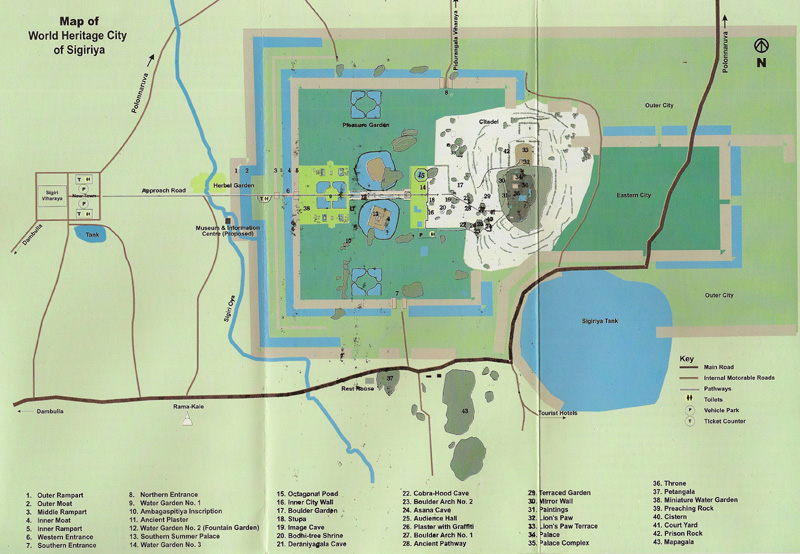
Ancient Rock City of Sigiriya

As we made our way out of the forest and into open fields my eyes were drawn towards the outcrop that was our destination. 
At first its size and scale were hard to judge. But as we approached the city, the walls and buildings below made the enormity of the rock apparent. Above our heads the palace clung to the top like Swallow's nest. It looked impenetrable. 
- An Account of Sundaland by Alom Takal 


Watch the short video for great images of this spectacular location. Find out more here: Wikipedia: Sigiriya and here: Ancient Rock City of Sigiriya.


Map of the area (right click and open in new tab for a closeup view)