Tuesday, March 7, 2023

The Gods and Religions of Sundaland

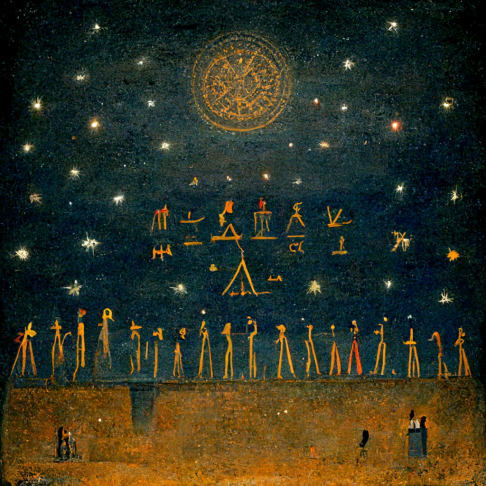
                                                    AI Image generated by Midjourney*

The priests were dizzy and swaying from the plant brew that they had ingested an hour earlier. Now, standing in front of each other, with an obsidian dagger in each of their hands, they were ready to fight to the death. The loser would be the sacrifice that would appease the gods of the rain winds and bring honour on his family and clan. The winner would have to leave the city with his family until the motion of the stars across the sky had completed a full cycle. The circular arena of red stone seated a baying crowd of thousands. They chanted along to the rhythm of their rattles and drums slowly increasing the tempo and volume to a crescendo. Suddenly the high priest-king, from his balcony, dropped a jade encrusted sceptre into the sandy floor below. The combatants lunged at each other, as best they could.

In this post I'll share some tables for learning more about the gods and religions of Sundaland. Use 1d6 if you want to generate random combinations. Many religions will share similar attributes but these tables will help you identify those that are most prominent.

My preference is to have a mixture of these ideas present across the various cultures to give that weird Sword & Sorcery culture shock experience. Embrace the contradictions, it doesn't have to make sense to our 21st century ways of understanding.

Personally, I've never been particularly interested in elaborate religious systems and expansive pantheons of gods in my RPG settings. Similarly to how I think about magic, I believe that by describing this aspect of a setting in systematic detail you remove an element of mystery and wonder. It starts to look like a hierarchical bureaucracy (although some of you may find that fun).

I've written some thoughts on this before and referenced some interesting articles in a previous post which discuss the topic of how people in ancient times really engaged with their religion: Shout Out: Practical Polytheism.

When I use terms such as gods, spirits etc. you can substitute all kinds of things; ancestors, ghosts, demons, beings from other dimensions and realities or even aliens.


Gods, spirits and other supernatural beings are...

1. Social constructs and a figment of people's imagination that are used as part of religion to understand or explain the world and their experiences in it. None of it is real and some people or non-human beings know this.

2. Spirits residing within animate (animals, people) and inanimate objects (tools, weapons, artefacts) or locations of significance such as waterfalls, caves, rivers, strangely shaped rocks etc. They make reality do what it does. Without them water wouldn't be wet, sharp things wouldn't cut and tigers wouldn't hunt deer.

3. Supernatural powers behind natural forces such as typhoons, earthquakes, droughts, volcanoes, wildfires, mudslides and deluges. 

4. Elemental beings associated with fire, water, air, earth and spirit.

5. The supernatural powers behind abstract concepts such as war, peace, commerce, music, bountiful hunting and harvests etc.

6. Aliens or beings from other worlds, dimensions, realms, times or realities (Elder Beings: Truth of the Star Gods).


Gods, spirits and other supernatural beings look like...

1. Normal humans, indistinguishable from ourselves.

2. Humans but exceeding us with far greater physical, mental or spiritual attributes. Or humans with some notable difference. For example unusual skin, eye or hair colours (for example blue skin, red eyes and green hair) or different anatomy such as wings, gills or tails.

3. Animals of Southeast Asia. For inspiration about the animals of Southeast Asia look here: The Fauna and Megafauna of Sundaland and here: Ecology Asia. Examples includes crocodiles, tigers, elephants, monkeys, water-buffalo, banteng, vultures, hyena and various birds, reptiles and amphibians.

4. A combination of animal and human anatomy.

5. Combinations of physical attributes of insects, mammals reptiles, birds, amphibians and invertebrates (which range from from insects and worms to jellyfish and octopuses). 

6. Things that aren't found in our world, universe or reality; Unusual combinations of what we would describe as wings, tentacles, claws, beaks, exoskeletons, multiple eyes, heads and limbs. Or perhaps material or non-material manifestations that the human mind can't even conceive of.


Gods, spirits and other supernatural beings posses abilities such as...

1. Only being able to affect reality in ways that are plausibly explained by natural forces. Earthquakes, mudslides, wildfires, typhoons, volcano outbursts, migrating animals, disease, famine and warfare.

2. Incredible strength, speed, agility, intelligence, bravery, prowess and other recognisable human or animal attributes and skills.

3. The ability to affect the hearts and minds of humans and animals so that it seems as if it was their own natural motivation at work.

4. The ability to affect or warp time and reality, locally or globally, for individuals or masses.

5. Bend the laws of nature such as making water run up hill, creating flames as cold as ice and making heavy things so light they float in the air.

6. Being able to create technology so advanced it could be considered magic when compared to human engineering. The technology harnesses electricity, steam or nuclear power, magnets, acoustics or magical metals. See also: Orichalcum: The Magical Metals of Sundaland


Religion is for...

1. Giving cultures a shared sense of meaning. It makes communities stronger and more resilient but can be used by some to influence or control people's thoughts and behaviour for ulterior motives.

2. Appeasing the gods and spirits to protect people from their malevolent will and destructive power.

3. Learning about other worlds, realms, the present, the past, predetermined or possible futures.

4. Enhancing or developing individuals, either spiritually, mentally or physically.

5. Improving the material wellbeing of people such as by increasing rainfall, healing the sick, improving the results for hunting and fishing expeditions, delivering success in battle or helping to find resources.

6. Protecting the culture from rival groups, natural forces, animals, diseases, beasts and monsters or other gods and supernatural beings.


People can communicate with the gods or spirits by...

1. Taking hallucinogenic substances or entering a trance state through chanting, dancing, singing, meditating or other forms of mental and physical stress.

2. Through dreams, visions, voices in nature or in their head.

3. Contemplating or observing nature for omens such as the movement of birds, tides and weather patterns. Or through astrology by watching the movement of the sun, moon, stars, planets and comets.

4. Casting bones, shell or stones. Inspecting entrails, burning or otherwise destroying particular objects or substances, or speaking with idols and statues.

5. Creating sigils, glyphs and other patterns with coloured sand, paint, woven materials or carvings.

6. By interacting with magical tools or technology created for the culture or that was lost or left behind by the gods, aliens or other beings.


Rituals involve...

1. Solitary practice.

2. Communal experiences.

3. Being led and guided by particular individuals, groups or castes.

4. Travelling to, or ritualistically walking around religious sites.

5. Sacrifices of offerings of some kind; animals, resources, tools, artefacts, opportunities, social standing or anything else of value.

6. Conflict, debate, discussion, competition, combat, games, sports or races.


Everyday religious practice for the average person involves...

1. Praying, meditating, inducing trance states.

2. Chanting, singing, playing musical instruments, dancing or story-telling.

3. Making sacrifices or offerings.

4. Enduring physical, mental or spiritual trials or hardship.

5. Consulting religious figures for advice or asking them to do rituals on their behalf.

6. Observing strict rules that govern every day activities such as interactions between people, cooking food, crafting, hunting, fishing, tending gardens, trade, commerce and resource extraction.


The religions of other cultures are...

1. Simply untrue and safely ignored.

2. True but less powerful and less consequential than our own.

3. Equally true and powerful as our own but deserves no special respect or treatment.

4. Equally true and powerful, should be respected and have as valid a right to exist as our own.

5. Equally true but more powerful than our own. Should be feared and respected.

6. Whether true or untrue, dangerous and must be destroyed.


Two more relevant sets of tables (there are many more in the Content Overview section found in the side bar):

Random Sundaland Culture Generator

Cultural Flavour Tables

*Using AI images on this blog

How do my readers feel about the use of AI / machine learning / algorithm generated images? I'm an artist myself and I understand the rise of this technology will have an impact on all kinds of artists, whether amateur or professional. However all the content on this blog is provided for free and so I do not have a budget to put towards new artwork. I'm open to opinions.

Real History: Discovery of Oldest Bow and Arrow Technology in Eurasia

"The origins of human innovation have traditionally been sought in the grasslands and coasts of Africa or the temperate environments of Europe. More extreme environments, such as the tropical rainforests of Asia, have been largely overlooked, despite their deep history of human occupation. A new study provides the earliest evidence for bow-and-arrow use, and perhaps the making of clothes, outside of Africa ~48-45,000 years ago –in the tropics of Sri Lanka."

Source: Discovery of Oldest Bow and Arrow Technology in Eurasia

Tuesday, February 28, 2023

Wednesday, December 14, 2022

Real History: Homo Floresiensis - Ancient Human

Dwarf Stegadon, giant rats, huge storks, Lomodo dragons and Homo Floresiensis. All existed thousands of years ago on islands to the south of Sundaland. Skip to 19:00 to see what the 'hobbit' people encountered on the island of Flores.

Sunday, December 11, 2022

Elephant Queens & Tiger Kings - 9: The Stolen Idol

(Click map to zoom)

In the last episode our galleys arrived at Nanbeg Gakwha a city of the Longheads and ended on a cliff hanger because I rolled a Weak Hit on the Reach Your Destination move.

On a Weak Hit you face an unforeseen hazard or complication. Envision what you find or Ask the Oracle. 

I need some inspiration for the complication so I'll roll on the Settlement Trouble, Action and Theme and the Major Plot Twist oracles.

Settlement Trouble table: 86: Stranger causes discord

Roll Action and Theme oracles.

Action: 14 Inspect. Theme: 75 Mysticism

Major Plot Twist: Someone or something goes missing.

Our galleys are moored at a large quay where dignitaries from the Longheads are waiting for us. Whether they are kings and queens, priests or warriors I don't know. Some of the most important looking of them are wearing tiger and leopard skins around their shoulders, their long heads decorated with brightly coloured feathers. Warriors carrying spears stand nearby, some of them with tattoos on their faces, dark circles under their eyes and the outlines of teeth around their mouths making them look like living skeletons. They are a frightful sight.

A translator is helping our leaders communicate with them, small gifts are exchanged and then the command is given to start unloading our cargo. We start lifting heavy bags, baskets and enclosed clay pots across the gangway on to the shore. It's clear that one of the goods we have brought with us is salt, something that's hard to come by so far from the sea. But I don't know what else we've transported. Whatever we are trading with each other, it must be valuable.

It seems from the conversation between our respective leaders that we are not going to immediately receive goods to bring back. We are beckoned get back on the galleys are then brought some food which consists of boiled meat and vegetables. Our leaders are taken into the city presumably for more lavish treatment.

We settle down on the on the benches of our boats or out on the deck, the smell incense is in the air in order to drive away the mosquitos. We sleep as best we can, our tiredness overcoming any trepidation.

A commotion wakes us abruptly in the morning, there is shouting from the deck above. We scramble from our resting places but before we can climb out a group of Longheads come below. Some shout at us and use their spears to corral us to one side while others frantically search every nook and cranny of the lower decks. After a while they seem satisfied and leave. One of the mariners comes down to explain that we have been accused of stealing a golden idol from one of their temples. They are currently holding all out ambassadors and emissaries captive and it's unlikely that they will let us leave until they've found it. We've found ourselves in a dangerous predicament.

I ask one of the mariners if it's possible for some of us to visit our leaders. 

Ask the Oracle 50/50: 50 or below is No, 51 or above is Yes.

73: Yes.

I'm told that we are allowed to visit them with an escort. I decide to ask if I can visit them in order to see how I can help. It's unusual for a rower to make a request like this but I believe that I've distinguished myself on this mission enough that the mariners will give me a chance, they are clearly at their wit's end, unsure how to proceed.

Move: Compel with Heart (+1)

Action Die: Roll 1d6 + Heart(+1), 3 + 1 = 4

Challenge Dice: Roll 2d10 = 6 and 3

Weak Hit: They'll do what I want +1 momentum (4 momentum) but they'll ask for something in return. Ask the Oracle if unsure.

The mariners will allow me to visit the ambassadors but they want me to credit them with any success. They ask me what my plan is but since I don't have one I'll lie.

Move: Secure an Advantage with Shadow (+1)

Action Die: Roll 1d6 + Shadow(+1), 2 + 1 = 3

Challenge Dice: Roll 2d10 = 7 and 31

Weak Hit: Advantage is short lived, take +1 momentum (5 momentum).

I make up something about having dealt with this kind of situation before, in normal circumstances it would not be convincing but the mariners are willing to go along with it for now out of pure desperation. My idea is to to visit them on the pretext that we are bringing them some food. I ask if I can bring a group including my friend Auko. He trusts me enough to want to come along but for the rest I will need some volunteers. 

1d10: 4  

Four others trust me enough to give whatever idea I have a chance. We gather some baskets of fruit, nuts and dried fish and wait for the mariners to speak to some of the guards at the quay. The communication between our respective people is not easy but eventually they seem to understand what we want and we are motioned forward. The spearmen escort us from the docks into the city. The main street is paved with large, flat limestone tiles, some buildings are of the same material, probably temples and other important buildings. But most of the smaller houses and huts are made from various organic materials such as wood and bamboo, the roofs being covered with large leaves or woven grass. A light drizzle starts to fall as this city is deep in the rainforest. 

We are taken further into the city, now there are only stone buildings, then through a set of bronze doors, through a corridor and then finally a reasonably large room where the captives are held. The room has small openings at the top of the walls letting in light and air but is otherwise lit by oil lamps. There are benches and recliners on which the ambassadors are sitting, 9 in total, 3 for each of our boats. The Longhead spearmen stand at the entrance while we bring in the baskets of food.

The ambassadors are surprised that we are there and ask who sent us. I tell them that the mariners wanted us to come and find out more about the situation. I ask the ambassadors what they know.

Move: Gather Information with Wits (+2)

Action Die: Roll 1d6 + Wits(+2), 3 + 2 = 5

Challenge Dice: Roll 2d10 = 5 and 6

Miss: On a miss, your investigation unearths a dire threat or reveals an unwelcome truth that undermines your quest. Pay the Price.

Thinking back to the complication that I introduced at the start of the session. The ambassadors seem to believe hat they're being set up by some priests who object to our presence. And they're using the disappearance of the idol as leverage. It may be that there are different factions within the city that are at odds with each other. I don't think we're in a situation where we can find the idol. It could be anywhere. Trying to force ourselves out could be incredibly dangerous. Perhaps if we somehow create a distraction? However we are in the middle of the city and our appearance is very distinctive.

I think we need to appeal to the other faction in the city and exploit the conflict between the two.

I'll generate details for the Priest Caste and for the other faction; Warrior Caste (The Longheads are a warrior culture ) with my Random RPG Faction Generator. Skim down for a narrative summary.

1. Caste or Faction Type: Warrior Caste

2. Origin: Splinter Group

3. Leadership: Council, Elected, self-appointed or selected on merit.

4. Motivation: Power

5. Method: Manipulate or Leverage: Using secret knowledge

6. Strength: Meticulous planning: Account for all possibilities and outcomes.

7. Weakness: Immoral

8. Secret or MacGuffin: Resource

8.6 Resource: Weapon

9. Complication: Need more or a specific resource

10. Inner Conflict: Competing whats. What should they be doing?

11. Outer Conflict: Political disruption: An unintended shift in the political environment is preventing the faction from achieving their goals.

12. Moral Compass: Let fate decide


1. Caste or Faction Type: Priest Caste

2. Origin: Local

3. Leadership: Elite. A small group of people.

4. Motivation: Revolution.

5. Method: Manipulate or Leverage: Hidden violence. Assassinations or secret raids.

6. Strength: Fanatical. Will stop at nothing to achieve their goals.

7. Weakness: They have a debt or someone has leverage over them.

8. Secret or MacGuffin: Person

8.6 Resource: Heir or claimant.

9. Complication: Need more or a specific resource.

10. Inner Conflict: Disputed leadership.

11. Outer Conflict: Direct opposition: Another faction or group is trying to stop them.

12. Moral Compass: Let fate decide.

Summary: 

There is a splinter group within the main warrior caste leadership. Some of the council members, motivated by power are plotting to remove other members to cement the position of their own clans. They've been trying to gather sufficient bronze spears and axes for their clan members but are struggling to get as many as they would like. The splinter group has been encouraged by the priest caste who believe the Longhead culture of this city is not adhering to their religion as they once did. 

The priests are becoming impatient and have resorted to subterfuge such as assassinations and now theft of the idol in order to stir up conflict. They want to show that the current leadership is ineffective. The splinter group of warriors is weary of making their big moves now and some of them are willing to out the conspiracy of the priests rather than risk showing their hand too soon. Our group is caught in the middle.

We are aware that we are being used in some kind of power struggle but aren't sure of the exact details. 

I think it's reasonable that we will be brought in front of the council of the warrior caste and the priests. 

Move: Secure an Advantage with Wits (+2)

Action Die: Roll 1d6 + Wits (+2), 2 + 4 = 6

Challenge Dice: Roll 2d10 = 5 and  7

Weak Hit: Advantage is short lived, take +1 momentum (6 momentum).

We decide that with what little we know that we need to get in front of the council as soon as possible. I coach the ambassadors into laying out a case to the guards as to why we should be brought before the council as soon as possible.

Move: Compel with Heart (+1)

Action Die: Roll 1d6 + Heart(+1), 5 + 1 = 6

Challenge Dice: Roll 2d10 = 5 and 3

A Strong Hit. They'll do what we want, take +1 momentum (7 momentum).

The ambassadors speak to the guards explaining that we have been thoroughly searched and no one has found the idol, in addition we have no reason to want to start any trouble since we want to keep up good relations between our cities. While the guards do not have a say as to when we will be brought before the council it so happens that some of them were observing us from a behind a curtain on a balcony above us.

The guards are called to escort us out, through various corridors to a large hall, perhaps three stories high. There are stone benches on raised platforms on which sit a dozen or so elders. It is much lighter in this room since there are large openings at the top of the walls, some birds are occasionally seen flying in and out.

With the aid of a translator the elders tells us about the accusations, however there is already bickering happening between them. The translator is continually interrupted and being given conflicting messages. Then some of the elders start shouting at each other. People start pushing and shoving each other, then some of the other people in the hall, nobles, priests and guards get involved in order to prevent a scuffle. 

Does the scene turn violent? Ask the Oracle. Unlikely 76 or higher: 58, no.

There is a lot of commotion but thankfully it doesn't look like any real violence breaks out. We are taken back to the holding room to await our fate.

Saturday, December 10, 2022

Real History: Denisovan - Ancient Human

A look at the Denisovans. From around the 22:00 it discusses the presence of Denisovans in Southeast Asia and Australia and how they mixed with modern humans, specifically the Melanesians, Papua New Guineans and Aboriginal people. This indicates migration along the Pacific coast in particular.

Monday, December 5, 2022

Real History: Rise and Fall of the Sea around Sundaland and Sahul

This animated map shows the rise and fall of sea levels around Sundaland over the centuries. From 04:30 it shows human migration paths.

This animated map shows the rise and fall of sea levels around Sahul, the area of what is now known as Australia and Papua New Guinea. It also shows the human migration paths from around the 4 minute mark.